


A strategic analysis for CMOs between disruption and prudence.
The advertising market is currently experiencing its “iPhone moment” – at least if you believe the headlines surrounding the introduction of advertisements in ChatGPT. For companies that have built high-performance Google Ads machines and SEO strongholds over years, an existential question arises: Do we need to shift our budgets immediately?
The answer is: Yes, but with a cool head.
The New Reality: From Keyword to Context
Until now, digital advertising was based on the intent behind a search term. ChatGPT breaks this model. Here, people don’t “search”; they “solve.” Ads no longer appear as disruptive factors next to search results but as part of a curated answer.
Three central theses on current developments (as of 2026):
- AEO (Answer Engine Optimization) replaces SEO
- Status: Uncertain. The weighting between organic AI mentions and paid placements is not yet stable. (Gartner Report 2025/26: GenAI Search Impact).
- Zero-Click Dominance
- Status: High. When the AI provides the answer, traffic to one’s own website drops massively. (Soft) conversion takes place within the chat environment. (Search Engine Land: “The Death of the Referral?”).
- Contextual Targeting 2.0
- Status: Validated. OpenAI does not use cookies but the current conversation flow. This is privacy-compliant but harder to control. (OpenAI Business Blog, January 2026).
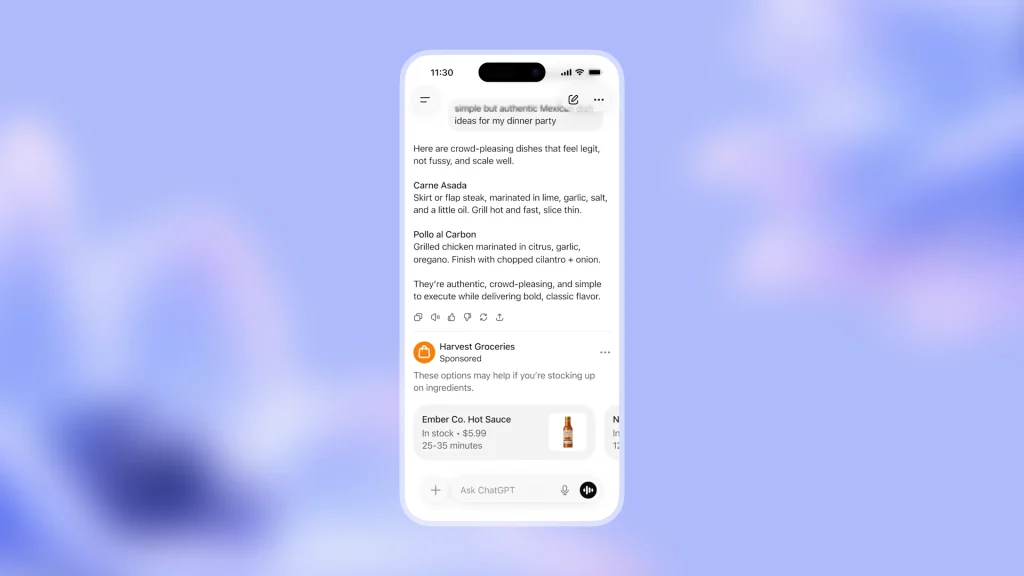
The Anatomy of the Answer
The interface marks a radical break from the classic list of results. ChatGPT and other LLMs bundle information into a final solution instead of just offering options. For CMOs, the placement of citations is just as crucial as the ads below the chat response. This is the birth of Answer Engine Optimization (AEO) combined with paid ad spaces. The critical question remains: How many users will still click on sources or obvious ads once their information need has been satisfied in the chat? Here, the “Zero-Click” trap threatens to become the new normal.
The Zero-Click Dilemma: When Traffic Dries Up but Relevance Increases
For the SEO-experienced CMO, this is a painful paradigm shift. For years, the website was the center of the digital universe. ChatGPT Ads break this dogma.
The Cannibalization of Content
The deal with search engines used to be simple: “We provide high-quality content; you provide us with qualified traffic.” In the world of Answer Engines (AEO), the power dynamic changes. The AI uses your content to formulate a perfect answer but gives the user little reason to click through to your site for details.
The “Content Paradox” in Numbers
We must re-evaluate success. If organic traffic falls but brand awareness remains stable through AI recommendations, the value chain shifts. Mathematically, the new Brand Value (Vb) in an AI environment can be simplified as follows:
Vb = (Eai x Cconv) + Tdir
- Vb: Brand Value
- Eai: Exposure within the AI response (Mention/Placement).
- Cconv: Conversion rate within the chat interface (e.g., via soft conversions or direct clicks to checkout processes).
- Tdir: Remaining direct traffic to the brand website.
The critical thesis: If Tdir (classic SEO success) approaches zero, Eai (presence in the response) must increase massively to maintain ROI. The problem: While we can bid for Position 1 on Google Ads, the logic by which ChatGPT deems a brand “trustworthy” within an answer remains a black box of billions of parameters.
Why “Traffic” is Becoming a Vanity Metric
In the ChatGPT world, “Share of Model” (how often and how positively the brand is mentioned in the model) is becoming the new lead currency.
OpenAI relies on discreetly colored “Tinted Boxes” to label ads as “Sponsored.” While this protects the user experience, marketers must critically ask whether this visual restraint can deliver the necessary click-through rates (CTR) compared to prominent top placements on Google.

The Danger of Blind Actionism
There is often a push in executive suites to be the “First Mover” in every technological shift. However, for CMOs whose current channels (Social Ads, Google) deliver stable double-digit ROAS, caution is advised:
- The Attribution Dilemma: Deep tracking tools like those from Meta or Google are still missing in ChatGPT Ads.
- Brand Safety & Hallucinations: It is not yet fully clear how ads are displayed if the AI generates factually incorrect or controversial answers. The risk of negative brand association is real.
- Fragmentation of Attention: Classic search won’t disappear overnight. A radical cut of Google budgets endangers the constant flow of leads.
- Social Media Ads vs. Intent-Based Ads: A critical mistake would be cutting social budgets in favor of ChatGPT. While Google/ChatGPT are “Intent-based,” Social Ads (Meta, TikTok) work “Predictively” to create demand before the user formulates it.

Strategic Recommendation: Pilot, Don’t Pivot
Instead of a hectic budget reallocation, we recommend a “Dual-Track Approach”:
- Protect the Core: Maintain your SEO and Google Ads strategy. These channels provide the data basis on which AI is trained. Without a strong website presence, you don’t exist for the AI.
- Isolated Pilot Projects: Define 5–10% of your test budget for ChatGPT Ads. The goal is learning: Which prompts trigger our ads? How can we influence LLMs with our data?
- AEO-Readiness: Start preparing your web content so it can be easily processed by LLMs (structured data, FAQ formats, clear entities).
- Leverage Predictive Power: Stick with Social Media Ads to capture user attention that ChatGPT cannot (yet) generate.
Critical Conclusion: ChatGPT Ads are changing the rules, but they aren’t erasing the old ones. The biggest danger for a CMO in 2026 is not using ChatGPT Ads too late, but tearing down a functioning foundation before the new one is sustainable.
Sources:
- OpenAI (January 2026): Our Approach to Advertising and Expanding Access to ChatGPT
- Core Content: Official statement regarding the pilot launch of ads in the U.S. (Free & Go Tiers), focusing on data privacy and the separation of ads from organic responses.
- Forbes / Terdawn DeBoe (January 26, 2026): ChatGPT Ads Just Changed The Rules Of Marketing Forever
- Core Content: An in-depth analysis of the disruptive nature of ChatGPT’s advertising integration and why the old rules of digital marketing are now obsolete.
- Meta Ads (2025/2026): Meta AI Advertising Automation & the Lattice Architecture
- Core Content: Details on the “Lattice” architecture, which automates predictive targeting based on trillions of signals and decouples social media ads from search intent.
- Google Newsroom (December 2025): The Search Evolution: Integrating AI Overviews into the Ad Ecosystem
- Core Content: Google’s adaptation of advertising models to the Generative Search Experience.
- Gartner Research (February 2024/2026): Gartner Predicts Search Engine Volume Will Drop 25% by 2026
- Core Content: The landmark forecast regarding the disruption of traditional search by AI chatbots and virtual agents.
- WARC (January 2026): Global Ad Spend Forecast 2026: The Rise of Social and Search Fragmentation
- Core Content: Current figures on advertising market growth (9.1% in 2026) and the stability of social media budgets compared to intent-based search.
- HubSpot Blog (January 2026): Answer Engine Optimization (AEO) Trends: How to stay visible in 2026
- Core Content: Practical strategies for optimizing content for LLMs and AI agents.
- Previsible.io (January 2026): ChatGPT Ads: The Data Opportunity for Marketers
- Core Content: Analysis of the significance of OpenAI’s data sharing for marketing attribution.
- The Marketing Eye (October 2025): ChatGPT Ads Could Change Digital Marketing Forever